Penguin

|

Wikipedia
Penguins are a group of aquatic, flightless birds living almost exclusively in the Southern Hemisphere, especially in Antarctica. Highly adapted for life in the water, penguins have countershaded dark and white plumage, and their wings have evolved into flippers. Most penguins feed on krill, fish, squid and other forms of sealife caught while swimming underwater. They spend about half of their lives on land and half in the oceans.
Penguin
Penguin
 Although all penguin species are native to the Southern Hemisphere, they are not found only in cold climates, such as Antarctica. In fact, only a few species of penguin live so far south. Several species are found in the temperate zone, and one species, the Galápagos penguin, lives near the equator. 

Source
image and info


NOTE: PLEASE Use the Older Post and Newer Post buttons just below comment box to navigate between posts.

ring-tailed mongoose

|
Ring-tailed mongoose
 ring-tailed mongoose 

The ring-tailed mongoose is a euplerid, a carnivoran native to Madagascar. There is actually much disagreement about the placement of Madagascar's carnivores including the ring-tailed mongoose, within the phylogenetic tree. Recent molecular work by Anne Yoder et al. (2003) reported in the journal "Nature" suggests that the Malagasy Carnivora evolved from a single herpestid ancestor. A monotypic genus, Galidia literally means "little weasel", being a diminutive form of galeē, ‘weasel’ in ancient Greek. Its local common name is vontsira mena, ‘red vontsira’ in Malagasy. The ring-tailed mongoose is relatively small but is the largest member of the subfamily Galidiinae. It is usually 32 to 38 cm (12.5 to 15 in) long and weighs only 700 to 900 g (24 to 32 oz). Its body is long and slender, and the rounded head has a pointed snout. The body is a dark red color and the feet are black. As the name implies, its bushy tail is covered with black and red rings. Ring-tailed mongooses are very agile, and good climbers. They are quite playful and are active during the day. Their habitat consists of humid forests. Their diet is mostly of small mammals, invertebrates, fish, reptiles and eggs, but they occasionally eat insects and fruit. The population of ring-tailed mongooses has decreased by 20% over the past ten years due to habitat loss. Another problem is competition with the small Indian civet.


Source:
 image Link:
Wikipedia Link:


NOTE: PLEASE Use the Older Post and Newer Post buttons just below comment box to navigate between posts.

Afghan Hound

|
Afghan Hound
Afghan Hound


The Afghan Hound is a hound that is one of the oldest dog breeds in existence. Distinguished by its thick, fine, silky coat and its tail with a ring curl at the end, the breed acquired its unique features in the cold mountains of Afghanistan. Its local name is Tāžī Spay or Sag-e Tāzī. Other alternate names for this breed are Kuchi Hound, Tāzī, Balkh Hound, Baluchi Hound, Barutzy Hound, Shalgar Hound, Kabul Hound, Galanday Hound, or sometimes incorrectly African Hound. Sighthounds are among the oldest recognisable types of dogs, and genetic testing has placed the Afghan Hound breed among those with the least genetic divergence from the wolf on some markers; this is taken to mean that such dogs are descended from the oldest dog types, not that the breeds tested had in antiquity their exact modern form.

Source:
Picture Link:
Wikipedia Link:

NOTE: PLEASE Use the Older Post and Newer Post buttons just below comment box to navigate between posts.

Phyllomedusa frog

|
Phyllomedusa Frog
Phyllomedusa frog

Phyllomedusa is a genus of tree frog from Central and South America. It ranges from Costa Ricasouthward to Argentina. It has around 30 species. Some Phyllomedusa species produce a waxy secretion that reduces the evaporative water loss of their bodies. If they begin to dry out, they move their limbs over their backs, where the secretory glands are, and spread the lipid secretion over their entire skin. Some indigenous groups from South America use the secretions of Phyllomedusa bicolor, the giant leaf frog, in shamanic hunting practices. The substance is said to intoxicate the hunters who ingest it, causing them to temporarily improve their sensorial capacities. In this genus of tree frogs, eggs are deposited on a leaf surface, interspersed with hydrating jelly capsules. During the mating process, the frogs fold the leaf around their batch of eggs using their limbs, with a jelly plug at the bottom of the folded leaf to prevent the eggs from falling out. Athatching, the jelly plug is liquified, and the tadpoles drop through the previously plugged hole. These nests are made above water, so the tadpoles drop into a suitable habitat, where they begin their lives as filter feeders.

Source:
Picture Link:
Wikipedia Link:

NOTE: PLEASE Use the Older Post and Newer Post buttons just below comment box to navigate between posts.

Guinea Pig

|
Guinea Pig
Guinea Pig

Guinea Pig is a series of seven controversial horror movie gore - slasher Japanese the years 1980 to 1990 . The series gained global notoriety mostly for the first two films, the series was used for scenes of brutal and extremely realistic violence in his films, which made ​​both the film producer had to prove that no one was actually injured or killed. The producer Hideshi Hino said that the original concept was to create a film adaptation of his work done in the manga . The Guinea Pig  series boasts probably the first rank among the greatest films of notoriety in the universe underground the horror end. In the year 1985 was released on the video market VHS a series called "Za ginipiggu", which showed atrocities and barbarities in scenes so real that many thought was a typical snuff. For years, sluts and rare copies circulated by the market - always with bad image - and helped turn the series, recorded in the format video and not film , the target of obsession on the part of film aficionados in extreme and cutting edge . 
Source:
Picture Link:
Wikipedia Link:

NOTE: PLEASE Use the Older Post and Newer Post buttons just below comment box to navigate between posts.

Siberian Husky

|
Siberian Husky
Siberian Husky


The Siberian Husky is a medium to large, dense-coat working dog breed that originated in north-eastern Siberia. The breed belongs to the Spitz genetic family. It is recognizable by its thickly furred double coat, sickle tail, erect triangular ears, and distinctive markings. Huskies are an active, energetic, and resilient breed whose ancestors came from the extremely cold and harsh environment of the Siberian Arctic. Siberian Huskies were bred by the Chukchi of Northeastern Asia to pull heavy loads long distances through difficult conditions. The dogs were imported into Alaska during the Nome Gold Rush and later spread into the United States and Canada. They were initially sent to Alaska and Canada as sled dogs but rapidly acquired the status of family pets and show dogs.
Source:
Picture Link:
Wikipedia Link:

NOTE: PLEASE Use the Older Post and Newer Post buttons just below comment box to navigate between posts.

Akhal-Teke

|
Akhal-Teke
Akhal-Teke


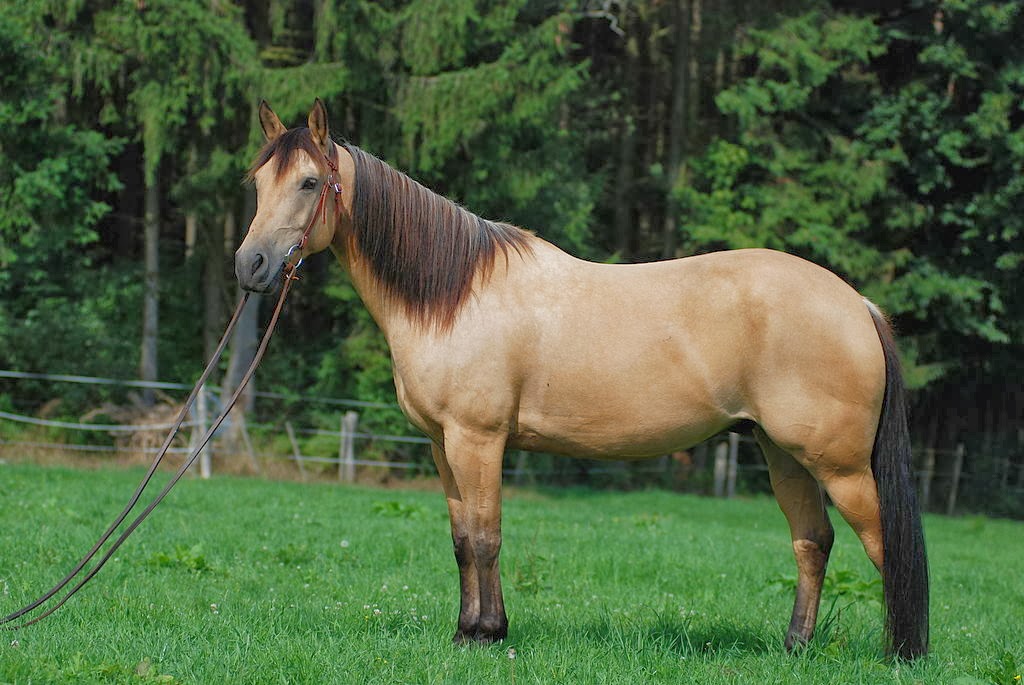
The Akhal-Teke is a horse breed from Turkmenistan, where they are a national emblem. They have a reputation for speed and endurance, intelligence, and a distinctive metallic sheen. The shiny coat of palominos and buckskins led to their nickname "Golden Horses". These horses are adapted to severe climatic conditions and are thought to be one of the oldest extant horse breeds. There are currently about 6,600 Akhal-Tekes in the world, mostly in Turkmenistan and Russia, although they are also found throughout Europe and North America. There are several theories regarding the original ancestry of the Akhal-Teke, some dating back thousands of years.
Source:
Picture Link:
Wikipedia Link:

NOTE: PLEASE Use the Older Post and Newer Post buttons just below comment box to navigate between posts.

Draco volans

|
Draco volans lizard
Draco volans

Draco volans, commonly known as the flying dragon, is a species of lizard endemic toSoutheast Asia. It is a member of the genus of gliding lizards Draco. It can spread out folds of skin attached to its movable ribs to form "wings" that it uses to glide from tree to tree overdistances upwards of 8 metres (26 ft); however, like all modern reptiles, it lacks the ability to sustain powered flight, and is capable only of gliding. Its wings are brightly coloured with orange, red and blue spots and stripes, and they provide camouflage when folded. The flying dragon can reach a total length of up to 23 centimetres (9.1 in). It feeds on arboreal ants and termites. 

Source:
Picture Link:
Wikipedia Link:

NOTE: PLEASE Use the Older Post and Newer Post buttons just below comment box to navigate between posts.

Cinnabar moth

|
Cinnabar moth
Cinnabar moth


The cinnabar moth is a brightly coloured arctiid moth, found in Europe and western andcentral Asia. It has been introduced into New Zealand, Australia and North America to control poisonous ragwort, on which its larvae feed. The moth is named after the redmineral cinnabar because of the red patches on its predominantly black wings. Cinnabar moths are about 20mm long and have a wingspan of 32–42 mm (1.3-1.7 in). Cinnabar moths are day-flying insects. Like many other brightly coloured moths, it is unpalatable; the larvae use members of the genus Senecio as foodplants. Many members of the genus have been recorded as foodplants, but for long-term population success, the presence of the larger species such as ragwort is needed. Smaller plant species, such as groundsel, are sometimes used, but since the species lays its eggs in large batches, survival tends to be reduced. Newly hatched larvae feed from the underneath of ragwort leaves within the area of their old eggs.

Source:
Picture Link:
Wikipedia Link:

NOTE: PLEASE Use the Older Post and Newer Post buttons just below comment box to navigate between posts.

American Yellow Warbler

|
American Yellow Warbler
 American Yellow Warbler 

The American Yellow Warbler is a New World warbler species. Sensu lato, they make up the most widespread species in the diverse Setophaga genus, breeding in almost the whole of North America and down to northern South America. Other than in male breeding plumage and body size, all subspecies are very similar. Winter, female and immature birds all have similarly greenish-yellow uppersides and are a duller yellow below. Young males soon acquire breast and, where appropriate, head coloration. Females are somewhat duller, most notably on the head. In all, the remiges and rectrices are blackish olive with yellow edges, sometimes appearing as an indistinct wing-band on the former. The eyes and the short thin beak are dark, while the feet are lighter or darker olive-buff.
Source:
Picture Link:
Wikipedia Link:

NOTE: PLEASE Use the Older Post and Newer Post buttons just below comment box to navigate between posts.

Whiskered Treeswift

|
 Whiskered Treeswift
Whiskered Treeswift
The Whiskered Treeswift is a species of bird in the Hemiprocnidae family. It is found inBrunei, Indonesia, Malaysia, Myanmar, the Philippines, Singapore, and Thailand.  Itsnatural habitats are subtropical or tropical moist lowland forests, subtropical or tropical mangrove forests, and subtropical or tropical moist montane forests.
See more info to visit wikipedia.

Source
link:image and info

NOTE: PLEASE Use the Older Post and Newer Post buttons just below comment box to navigate between posts.

Boxer Dog

|
Boxer Dog
Boxer Dog


A Boxer is a breed of stocky, medium-sized, short-haired dogs bred in Germany. Their coat is smooth and tight-fitting; colors are fawn or brindled, with or without white markings, which may cover the entire body. Boxers are brachycephalic (they have broad, short skulls), and have a square muzzle, mandibular prognathism (an underbite), very strong jaws, and a powerful bite ideal for hanging on to large prey. The Boxer was bred from the Old English Bulldog and the now extinct Bullenbeisser, and is part of the Molosser group. Boxers were first exhibited in adog show for St. Bernards in Munich in 1895, the first Boxer club being founded the next year. Based on 2012 American Kennel Club statistics, Boxers held steady as the seventh most popular breed of dog in the United States for the third consecutive year.

source:
pic:
wikipedia:

NOTE: PLEASE Use the Older Post and Newer Post buttons just below comment box to navigate between posts.

American Quarter Horse

|
American Quarter Horse
 American Quarter Horse

The American Quarter Horse is an American breed of horse that excels at sprinting short distances. Its name came from its ability to outdistance other horse breeds in races of a quarter mile or less; some individuals have been clocked at speeds up to 55 mph. The American Quarter Horse is the most popular breed in the United States today, and the American Quarter Horse Association is the largest breed registry in the world, with more than 5 million American Quarter Horses registered. The American Quarter Horse is well known both as a race horse and for its performance in rodeos, horse shows and as a working ranch horse. The compact body of the American Quarter Horse is well-suited to the intricate and speedy maneuvers required in reining, cutting, working cow horse, barrel racing, calf roping, and other western riding events, especially those involving live cattle. The American Quarter Horse is also shown in English disciplines, driving, and many other equestrian activities. In the 17th century, colonists on the eastern seaboard of what today is the United States began to cross imported English Thoroughbred horses with assorted "native" horses such as the Chickasaw horse, which was a breed developed by Native American people from horses descended from Spain, developed from Iberian, Arabian and Barb stock brought to what is now the Southeastern United States by the Conquistadors.
Source:
Picture Link:
Wikipedia Link:

NOTE: PLEASE Use the Older Post and Newer Post buttons just below comment box to navigate between posts.

longhorn cowfish

|
http://galaxyanimals.blogspot.com/
longhorn cowfish

The longhorn cowfish, Lactoria cornuta, is a variety of boxfish from the family Ostraciidae, recognizable by its long horns that protrude from the front of its head, rather like those of a cow or bull. They are a resident of the Indo-Pacific region and can grow up to 20 inches long. While badly suited to the home aquarium, the cowfish is becoming increasingly popular as a pet. Adults are reef fish, often solitary and territorial, live around sand or rubble bottom up to a depth of 50 m. They are omnivorous, feeding upon benthic algae, various microorganisms, and foraminiferans that it strains from sediments, sponges, polychaete worms from sand flats, mollusks, small crustaceans, and small fishes, able to feed on benthic invertebrates by blowing jets of water into the sandy substrate. Its primary habitat is coral reefs in lagoons, on reef flats, and on protected seaward reefs. Juvenilesassociate with Acropora corals. Depth range is 3.3–148 ft (1–45 m, perhaps up to 100 m). Red Sea and East Africa eastward through Indonesia to Marquesas, northward to southern Japan. Including Tuamotus, southern Korea, north to the Ryukyu Islands of southern Japan, south to Australia and Lord Howe Island, and off southern Africa in the Atlantic. Tropical and subtropical waters.


Source:
Picture Link:
Wikipedia Link:

NOTE: PLEASE Use the Older Post and Newer Post buttons just below comment box to navigate between posts.

Dolphins

|
http://galaxyanimals.blogspot.com/
Dolphins

Dolphins are marine mammals closely related to whales and porpoises. There are almost forty species of dolphin in 17 genera. They vary in size from 1.2 m (4 ft) and 40 kg (90 lb) , up to 9.5 m (30 ft) and 10 tonnes . They are found worldwide, mostly in the shallower seas of the continental shelves and are carnivores, eating mostly fish and squid. The family Delphinidae, the largest in the Cetacean order, evolved relatively recently, about ten million years ago during the Miocene. The name is originally from Greek δελφίς ,dolphin", which was related to the Greek δελφύς , "womb". The animal's name can therefore be interpreted as meaning "a 'fish' with a womb". 
Source:
Picture Link:
Wikipedia Link:

NOTE: PLEASE Use the Older Post and Newer Post buttons just below comment box to navigate between posts.

Stingrays

|
http://galaxyanimals.blogspot.com/
Stingrays

Stingrays are a group of rays, which are cartilaginous fishes related to sharks. They are classified in the suborder Myliobatoidei of the order Myliobatiformes and consist of eight families: Hexatrygonidae (sixgill stingray), Plesiobatidae, Urolophidae (stingarees), Urotrygonidae (round rays), Dasyatidae (whiptail stingrays), Potamotrygonidae (river stingrays), Gymnuridae (butterfly rays), and Myliobatidae (eagle rays). Most stingrays have one or more barbed stingers on the tail, which are used exclusively in self-defense. The stinger may reach a length of approximately 35 cm (14 in), and its underside has two grooves with venom glands. The stinger is covered with a thin layer of skin, the integumentarysheath, in which the venom is concentrated. A few members of the suborder, such as the manta rays and the porcupine ray, do not have stingers. Stingrays are common in coastal tropical and subtropical marine waters throughout the world, and also includes species found in warmer temperate oceans, such as Dasyatis thetidis, and those found in the deep ocean, such as Plesiobatis daviesi. The river stingrays, and a number of whiptail stingrays, are restricted to fresh water. Most myliobatoids are demersal, but some, such as the pelagic stingray and the eagle rays, are pelagic. While most stingrays are relatively widespread and not currently threatened, for several species, the conservation status is more problematic, leading to them being listed as vulnerable or endangered by IUCN. 

Source:
picture Link:
Wikipedia Link:

NOTE: PLEASE Use the Older Post and Newer Post buttons just below comment box to navigate between posts.

Kingfishers

|
http://galaxyanimals.blogspot.com/

Kingfishers
Kingfishers are a group of small to medium sized brightly coloured birds in the order Coraciiformes. They have a cosmopolitan distribution, with most species being found in the Old World and Australasia. The group is treated either as a single family, Alcedinidae, or as a suborder Alcedines containing three families, Alcedinidae, Halcyonidae , and Cerylidae . There are roughly 90 species of kingfisher. All have large heads, long, sharp, pointed bills, short legs, and stubby tails. Most species have bright plumage with little differences between the sexes. Most species are tropical in distribution, and a slight majority are found only in forests. They consume a wide range of prey as well as fish, usually caught by swooping down from a perch. Like other members of their order they nest in cavities, usually tunnels dug into the natural or artificial banks in the ground. A few species, principally insular forms, are threatened with extinction. In Britain, the word 'kingfisher' normally refers to the Common Kingfisher.
The taxonomy of the three families is complex and rather controversial. Although commonly assigned to the order Coraciiformes, from this level down confusion sets in.
The kingfishers were traditionally treated as one family, Alcedinidae with three subfamilies, but following the 1990s revolution in bird taxonomy, the three former subfamilies are now often elevated to familial level. That move was supported by chromosome and DNA–DNA hybridisation studies, but challenged on the grounds that all three groups are monophyletic with respect to the other Coraciiformes. This leads to them being grouped as the suborder Alcedines.
The tree kingfishers have been previously given the familial name Dacelonidae but Halcyonidae has priority.
The centre of kingfisher diversity is the Australasian region, but the group is not thought to have originated there. Instead, they evolved in the Northern Hemisphere and invaded the Australasian region a number of times. Fossil kingfishers have been described from Lower Eocene rocks in Wyoming and Middle Eocene rocks in Germany, around 30–40 million years ago. More recent fossil kingfishers have been described in the Miocene rocks of Australia. Several fossil birds have been erroneously ascribed to the kingfishers, including Halcyornis, from the Lower Eocene rocks in Kent, which has also been considered a gull, but is now thought to have been a member of an extinct family.

Source:
Picture Link:
Wikipedia Link:


NOTE: PLEASE Use the Older Post and Newer Post buttons just below comment box to navigate between posts.

Asian Fairy bluebird

|
http://galaxyanimals.blogspot.com/
 Asian Fairy-bluebird 

The Asian Fairy-bluebird (Irena puella) is a medium-sized, arboreal passerine bird.
This fairy-bluebird is found in forests across tropical southern Asia from the Himalayan foothills, India and Sri Lanka east through Indochina, the Greater Sundas and Palawan (Philippines). Two or three eggs are laid in a small cup nest in a tree. It was described by British ornithologist John Latham in 1790. The only other member of the genus and family is the Philippine Fairy-bluebird, I. cyanogastra, which replaces the Asian Fairy-bluebird in most of the Philippines.
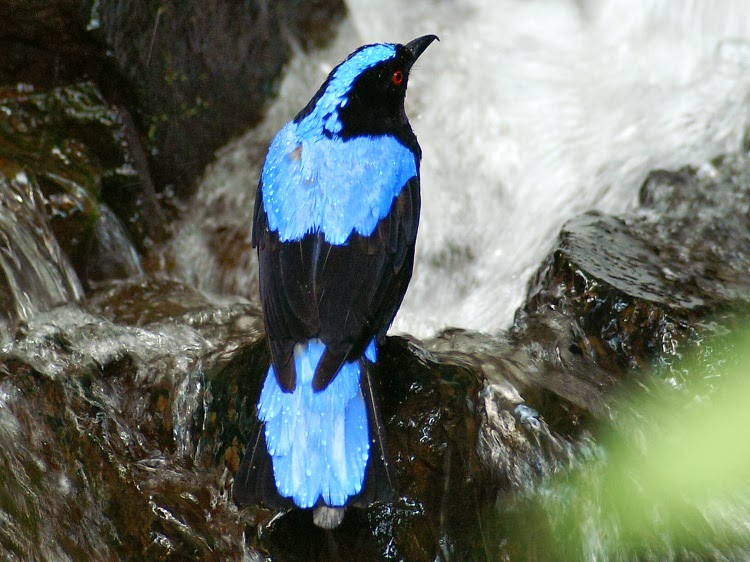
The adult Asian Fairy Bluebird is about 24 to 27 centimetres (9.4 to 11 in). The male has glossy, iridescent blue upperparts, and black underparts and flight feathers. The female and first year male are entirely dull blue-green.
The Asian Fairy Bluebird eats fruit, nectar and some insects. Its call is a liquid two note glue-it.
The Asian Fairy Bluebird measures 24 to 27 centimetres (9.4 to 11 in) in length. The iris is crimson and eyelids pinkish; the bill, legs and claws are black, and mouth a flesh- colour. Marked sexual dimorphism is evident. The male is a shining ultramarine-blue with lilac reflections on its upper plumage, lesser wing coverts, and under tail coverts, while the sides of its head and the whole lower plumage are deep black; greater wing-coverts, quills, and tail black, and some of the coverts tipped with blue, and the middle tail-feathers glossed with blue.
The upper plumage, the lesser wing coverts, and the lower tail coverts of the female are brownish blue, with the edges of the feathers brighter. The middle tail feathers and the outer webs of all the others, except the outer pair, like the upper plumage, and remainder of tail dark brown. primaries and secondaries dark brown. The greater wing coverts, primary coverts, and tertiaries dark brown, with a blue tinge on the outer webs. Sides of the head and whole lower plumage blue, very similar to the upper parts. The young resemble the female. The male changes into adult plumage in March, the change taking place without a moult. The feathers of the upper parts first become fringed with bright blue, then the tail coverts change, and finally the lower plumage changes. Young birds with the lower plumage mixed black and dull blue, and the upper plumage like that of the adult are frequently seen.
There are several subspecies, including I. cyanea malayensis from the Malay Peninsula, where the male differs in having the undertail coverts longer, nearly reaching to the tip of the tail.

Source:
Picture Link:
Wikipedia Link:

NOTE: PLEASE Use the Older Post and Newer Post buttons just below comment box to navigate between posts.

Javan Hawk-Eagle

|
http://galaxyanimals.blogspot.com/
Javan Hawk-Eagle 

The Javan Hawk-Eagle is a medium-sized, approximately 60 cm long, dark brown raptor in the family Accipitridae. Its head and neck are rufous and it is heavily barred black below. It has a long black crest with a white tip. The sexes are similar. The young is duller and has unmarked underparts.
An Indonesian endemic, the Javan Hawk-Eagle occurs in humid tropical forests of Java. Its range in East Java includes Sempu Island, Bromo Tengger Semeru National Park, Meru Betiri National Park and Alas Purwo National Park. It can also be seen in captivity in zoos like Kebun Binatang Bandung
The Javan Hawk-Eagle is believed to be monogamous. The female usually lays one egg in a nest high on top of a forest tree. The diet consists mainly of birds, lizards, fruit bats and mammals.
The Javan Hawk-Eagle is the national bird of Indonesia, where it is commonly referred to as Garuda, from the bird-like creatures in Hindu and Buddhist myths. The scientific name commemorates Hans Bartels.
Because of the plumage variability of Spizaetus eagles, the Javan Hawk-Eagle was not recognised as a full species until 1953.
It is one of the rarest raptors. Due to ongoing habitat loss, small population size, limited range and hunting in some areas, it is evaluated as Endangered on the IUCN Red List of Threatened Species. It is listed on Appendix II of CITES.
In February 2012, there were only around 325 pairs of Javan Hawk-Eagles living in the wild, mainly in Malangbong, West Java forest area and some in East Java, but in Central Java, Mount Merapi forest area is denuded by eruptions and Dieng plateau forest area is denuded for agriculture. The adaptation of the bird is very difficult due to they prefer endemic Rasamala tree and endemic Javanese rat for their diet. Ideally the population should be 1,450 pairs and without conservation the eagle predicted will extinct in 2025.

Source:
Picture Link:
Wikipedia Link:


NOTE: PLEASE Use the Older Post and Newer Post buttons just below comment box to navigate between posts.

Vulture

|
http://galaxyanimals.blogspot.com/
Vulture
Vulture is the name given to two groups of convergently evolved, usually scavenging birds of prey: the New World vultures, including the Californian and Andean Condors; and the Old World vultures, including the birds that are seen scavenging on carcasses of dead animals on African plains. Research has shown that some traditional Old World Vultures (including the Bearded Vulture) are not closely related to the others, which is why the vultures are to be subdivided into three taxa rather than two. New World vultures are found in North and South America; Old World vultures are found in Europe, Africa and Asia, meaning that between the two groups, vultures are found on every continent except Australia and Antarctica.  A particular characteristic of many vultures is a bald head, devoid of normal feathers. Although, it has been historically believed to help keep the head clean when feeding, research has shown that the bare skin may play an important role in thermoregulation. Vultures have been observed to hunch their bodies and tuck in their heads in the cold, and open their wings and stretch their necks in the heat.
See more info to visit wikipedia

Source
link:image and information

NOTE: PLEASE Use the Older Post and Newer Post buttons just below comment box to navigate between posts.